Operate.
Get to know your spacecraft. Work with thrust, attitude, navigation, power, and heat. Learn when to take the controls and when to trust your instruments.
Departure 2150
An entire Solar System.
A spacecraft to make your own.
Learn your ship. Make the crossing. Find your livelihood between worlds.
 JUPITER / FLIGHT DECK
01 / The experience
Departure 2150 is being built for people who find satisfaction in the flight itself. The instruments. The decisions. The moment a distant destination becomes the view outside your cockpit.
Get to know your spacecraft. Work with thrust, attitude, navigation, power, and heat. Learn when to take the controls and when to trust your instruments.
The planned freight loop gives every crossing a purpose: take a contract, earn your next upgrade, and work toward a ship that opens up new possibilities.
Fly above landscapes shaped by real planetary data. Find a new perspective on familiar worlds, from the lunar surface to the reaches of the outer system.
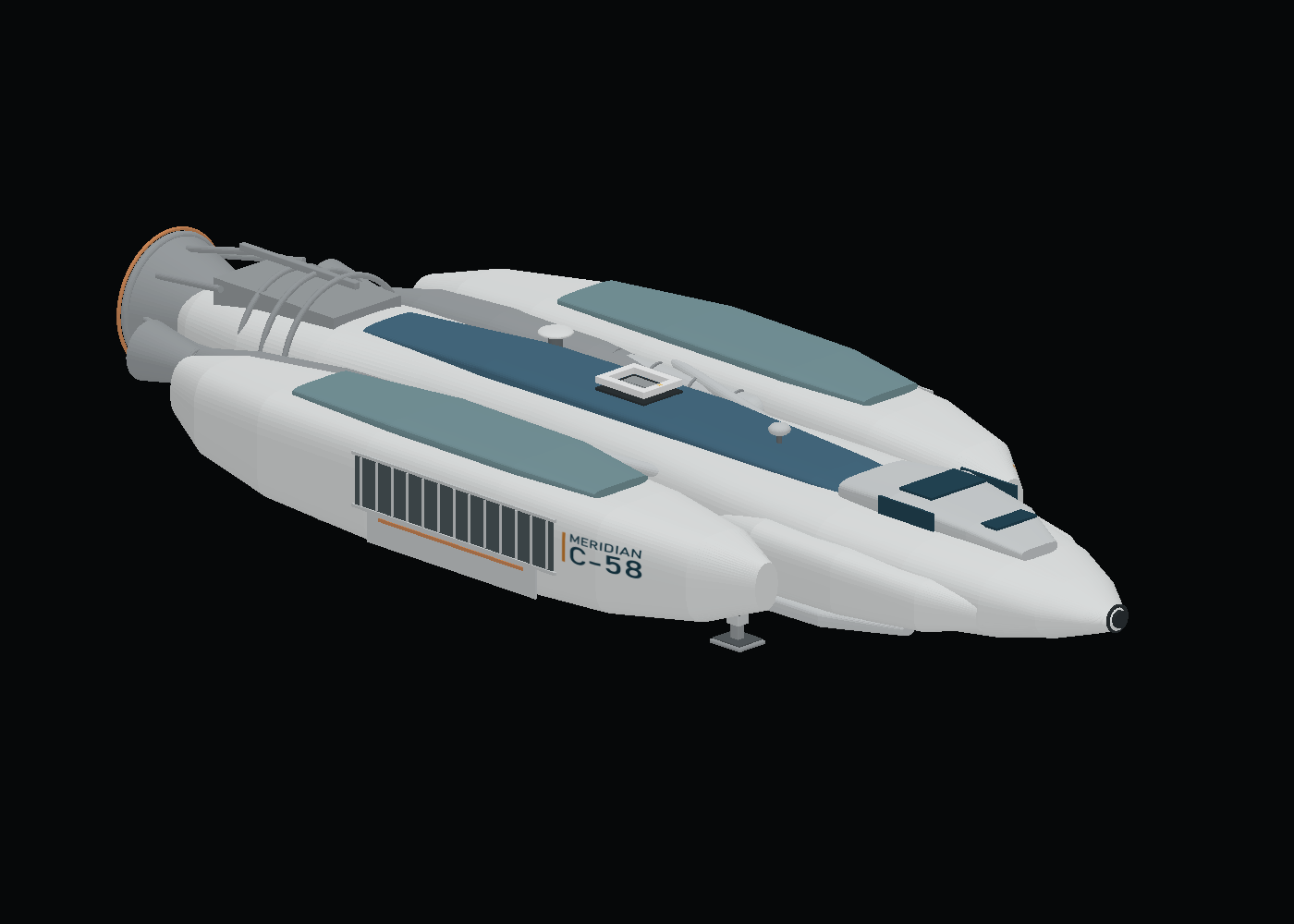
Every vessel gives a different shape to the journey. The C-58 is part of the project's current ship designs; freight progression and upgrades are being built for the first release.
02 / The long haul
Space is vast. A crossing is an operation: departure, acceleration, cruise, braking, and the final approach to a moving destination.
Autonav is central to the vision. Manage the flight, monitor the ship, and develop the confidence to let its systems do their work.
Current design targets range from roughly 4–10 hours in a starter ship to around an hour in an advanced vessel. Planetary geometry and final propulsion balancing affect these times.
Extended automated flight is part of the intended experience. The extent of unattended operation, arrival assistance, and intervention requirements is still being developed.
Spacecraft mastery is an important part of the game. Flight assistance will support learning; the opening tutorial and assistance defaults are still being designed.
03 / The worlds between
Humanity has become an interplanetary industrial civilization. Follow its reach from Earth and Luna to the Jovian system, and look beyond the edge of settlement.
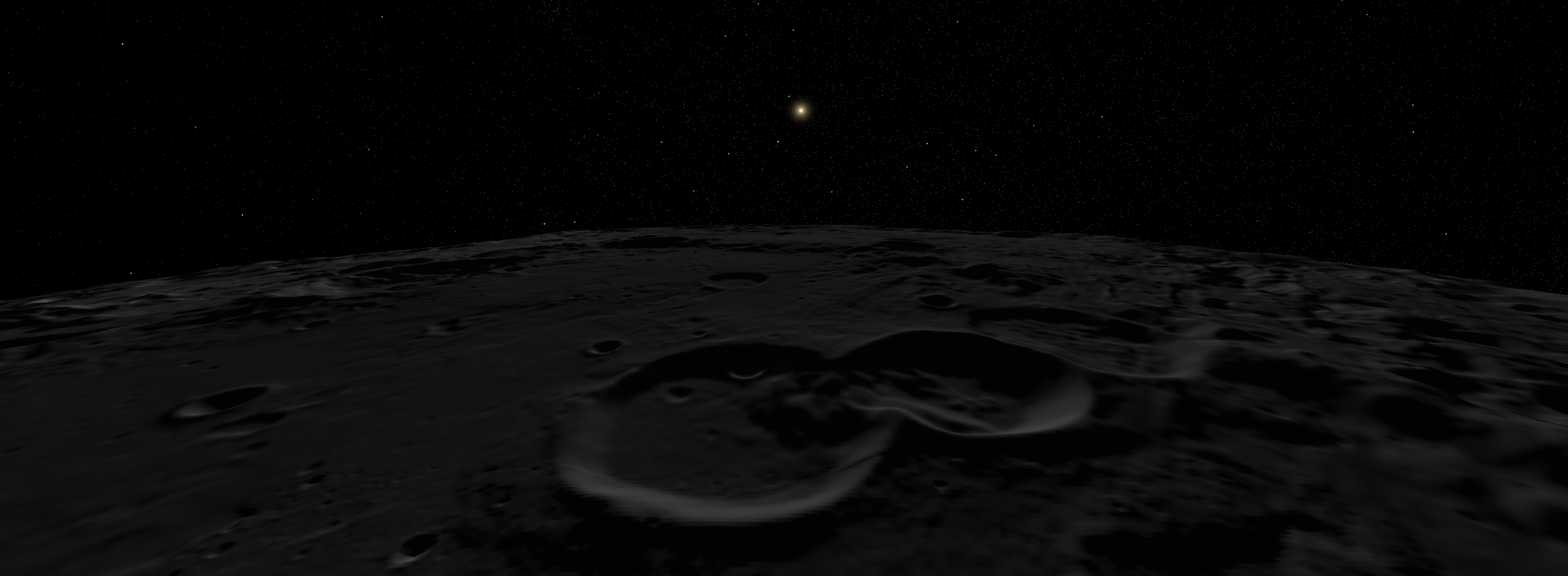
Where the journey begins
Orbital infrastructure, lunar facilities, and departures from Port Imbrium.
The working Solar System
Long crossings, industrial destinations, and a livelihood built between worlds.
The edge of settlement
A distant commercial anchor, with mining and research destinations planned.
The open frontier
An unsettled outer system. Distance becomes an expedition in its own right.
World direction for the initial release. Facilities and destinations are still in development.
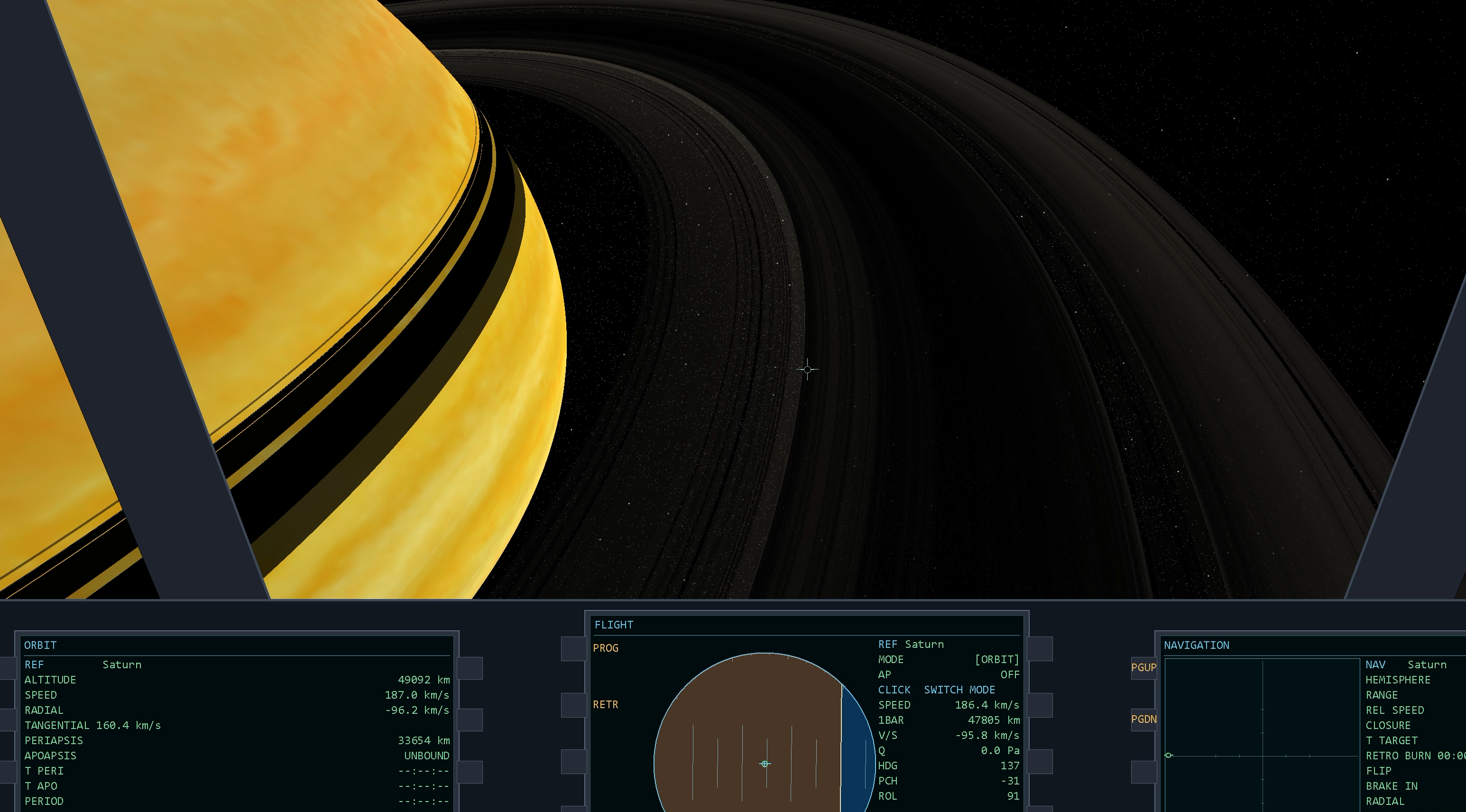
Planetary landscapes built from NASA and other scientific datasets give exploration a physical foundation. The view is part of the reason to fly.
04 / Inside the simulation
Follow the questions behind the experience. The mechanics of a moving Solar System. The data beneath a landscape. The engineering assumptions behind the spacecraft.
The laws behind the flight
The technology belongs to 2150. The mathematics begins with the universe we know.
01 / Newton
A spacecraft in orbit is continuously falling around a world. Its sideways motion carries it onward as gravity bends its path.
Motion and gravity work together. Reaching an orbital altitude is only part of the task; your velocity determines the path that follows.
F is gravitational force; G is the gravitational constant; M and m are the masses; r is their separation. This expression describes point masses or non-overlapping spherical bodies.
02 / Kepler
In an ideal two-body system, larger orbits take longer to complete. The destination continues its journey while you make yours.
An arrival is a meeting with a moving destination. Where it will be when you arrive matters, along with the velocity you bring to the encounter.
T is orbital period; a is the semi-major axis of the relative orbit. This is Kepler's third law in its Newtonian form, for a bound two-body orbit. Additional bodies make real trajectories more complex.
03 / Einstein
At significant fractions of light speed, special relativity becomes essential to describing momentum and energy.
High-speed travel changes the relationship between speed, momentum, and energy. Accelerating and braking become increasingly demanding as speed approaches the speed of light.
γ is the Lorentz factor; v is speed in the chosen inertial frame; c is the speed of light. At everyday speeds, this factor is very close to one.
Why an interplanetary flight is an interception.
Read the flight note Planetary data / Introductory noteConnecting planetary data to the view from your ship.
Read the terrain noteEstablished physics. Speculative 2150 technology. Explicit boundaries.
Our technical writing will explain where each belongs.
05 / From the flight deck
A commercial simulator and a long-term passion project. Follow the engineering, the experiments, and the flights that make the work worthwhile.
Read the opening development noteYour next departure
Steam will be the home for the game. Follow development through recorded flights, engineering updates, and the ongoing simulation stream.